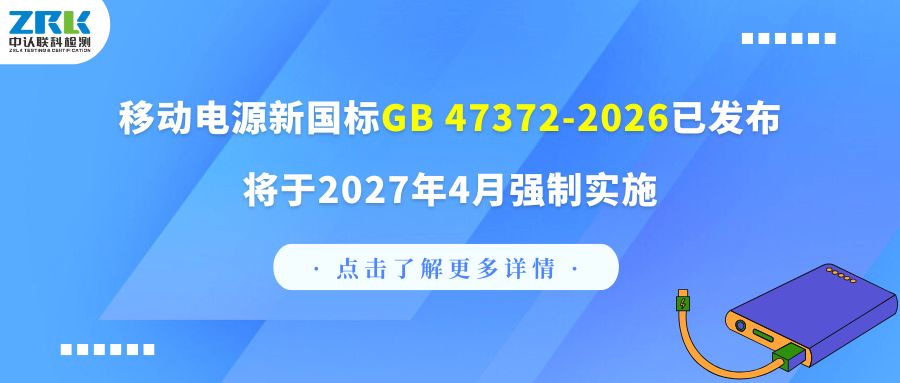
On March 31st, 2026, China's first national standard "Technical Specification for Mobile Power Safety" (GB 47372-2026) was officially released, and will be enforced on April 1st, 2027. The introduction of this standard is not only a comprehensive upgrade of the mobile power industry (commonly known as "charging treasure" and "outdoor power supply"), but also directly related to the market access and product compliance of enterprises.
Background and significance of the release of new national standard for mobile power supply
With the continuous expansion of the mobile power market, products are deeply bound to consumers' daily lives. However, there are long-standing problems such as uneven technology and uneven product quality in the industry, and frequent fire accidents in public transportation fields such as civil aviation have seriously threatened public safety. The release of GB 47372-2026 aims to solve the pain points of the industry from the source. The core significance lies in:
◆ Improve the safety level of products and reduce the hidden dangers of fire accidents from the whole chain of design, materials and production.
◆ Improve the certification and testing system, improve the market access threshold and eliminate non-compliant products.
◆ Standardize the competition order of the industry and promote the healthy and high-quality development of the industry.
Scope of application of new national standard products
This standard is applicable to mobile power pack (charging treasure) and portable energy storage power supply (outdoor power supply), covering all civil mobile power supply products sold to consumers. Enterprises need to complete the compliance upgrade of all categories of products in advance.
New national standard adds core requirements.
1. Improvement of identification and traceability system
★ New identification requirements:
◆ Product uniqueness code: each mobile power supply is marked with an exclusive "ID number"
◆ Suggested safe service life: mandatory service life reminder.
◆ Battery brand information: You can inquire about battery brand, production date, etc.
◆ Implement standard marking: clearly mark "GB 47372-2026"
★ Warning description requirements:
◆ Falling and bumping may bring safety risks.
◆ Do not place in high temperature environment.
◆ Do not continue to use it in case of severe swelling.
◆ It is forbidden to disassemble, squeeze or throw into the fire.
2. Core technology upgrade of battery safety testing project
★ Add test items
◆ A new acupuncture test was added: the battery core will not catch fire or explode after being penetrated by a tungsten steel needle with a diameter of 4mm (it was first introduced in consumer batteries to simulate extreme internal short circuit).
◆ Add cycle aging lithium precipitation test: disassemble and detect the lithium precipitation area after 300 charge and discharge cycles (control the risk of internal short circuit after long-term use and ensure the safe operation of lithium battery system).
◆ Thermal runaway test: The battery composed of portable energy storage power supply needs to pass the thermal runaway test (for the special safety requirements of large-capacity batteries).
★ Tightening test conditions
◆ Thermal abuse test: The test temperature was raised from 130℃/30min to 135℃/60min to verify the stability of high temperature environment.
◆ Extrusion test: the extrusion pressure is increased from 13kN for plane extrusion to 20kN for round bar extrusion, so as to strengthen the anti-extrusion protection ability.
◆ Overcharge test voltage: The charging limit voltage is increased by 1.3 times, which verifies the safety in the overcharge scene.
◆ Protection circuit: upgraded from the original standard "primary protection" to "secondary protection", completely eliminating the risk of battery overvoltage charging.
3. Innovative introduction of intelligent management functions (Article 6.8)
The new standard explicitly requires the mobile power supply to have intelligent management function for the first time, which is an unprecedented breakthrough requirement in the previous standards. The details are as follows:
★ Requirements for real-time monitoring:
◆ Single-stage battery voltage monitoring, the measurement error is less than 1% (the accuracy of voltage measuring device is 0.1%);
◆ For battery temperature monitoring, the measurement error is 3℃ within 70℃ and 6℃ above 70℃. The most unfavorable position of the battery should be selected for temperature measurement, so as to ensure that the risk can be effectively perceived (the temperature acquisition device is placed in a constant temperature tank with the measurement accuracy not lower than 0.5℃).
★ Abnormal information storage requirements:
◆ Battery overcharge pressure record: record the most unfavorable value stored in the 1h interval under the overcharge state of each level of battery;
◆ Record of abnormal temperature of battery or battery pack: every 1h interval, store the highest temperature value of this period;
◆ Record of the above-mentioned abnormal occurrence time.
★ User reading function:
◆ Stored abnormal state information
◆ Model and code of the battery (it should be able to analyze the manufacturer and production date information)
◆ Reading methods include mobile power supply with its own TFT display screen, wired or wireless connection to mobile phone and computer, etc.
4. Forward-looking design of voltage regulation function (Article 6.9)
The new standard requires that the mobile power supply has the function of adjusting the maximum charging voltage of the battery or battery pack, which should be adjusted in one of the following two ways:
★ The maximum charging voltage is adjusted with time.

★ The maximum charging voltage is adjusted with the number of cycles.

Objective: With the increase of product use time and cycle times, the highest charging voltage is automatically reduced, the aging rate of battery is slowed down from the root, the cycle life is simultaneously prolonged and the long-term use safety is improved.
5. Active protection of abnormal disabling function (Article 6.10)
According to the latest safety standards, mobile power supply must integrate voltage protection mechanism. When the voltage is too low or too high, the equipment will automatically stop working, effectively preventing damage caused by abnormal voltage. The details are as follows:
◆ Under-voltage disabling function: After the mobile power supply is discharged, adjust the battery voltage of any level to 0.4*Udo (battery discharge cut-off voltage) for 10s, and then maintain the voltage at 0.4*Udo. At this time, the mobile power supply should be charged and discharged, and the mobile power supply should not be able to charge and discharge;
◆ Overvoltage disabling function: After the mobile power supply is fully charged, adjust the battery voltage of any level to the battery upper limit voltage Uup+0.3V, and keep it for 2s, and then keep the voltage higher than the battery upper limit voltage (UUP)+0.3V. At this time, the mobile power supply is discharged and charged, and the mobile power supply should not be able to charge and discharge.
Note: The disable function is designed as one-time irrecoverable. Once the protection condition is triggered, the product master will be permanently locked immediately, and any form of restart or reuse is absolutely prohibited, thus eliminating the possibility of "running with disease" from the source.
6. Source management of battery material control (Chapter 8)
For the first time, the new standard includes the requirements of battery materials into mandatory regulations, and clearly stipulates the metal impurities of anode and cathode materials and the strength of separator, so as to reduce the risk of short circuit inside the battery.
★ Requirements for cathode materials:
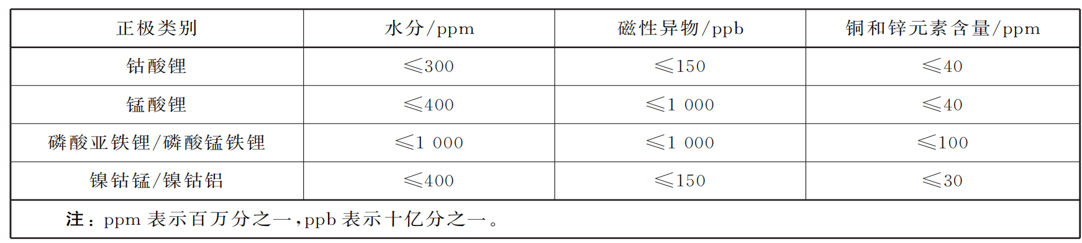
★ Requirements for cathode materials
◆ Graphite material: magnetic foreign matter content ≤1ppm, iron content ≤50ppm, copper and zinc content ≤40ppm.
◆ Silicon-carbon material: magnetic foreign matter content ≤1.5ppm, iron content ≤150ppm, copper and zinc content ≤40ppm.
◆ Hard carbon materials: magnetic foreign matter content ≤3ppm, iron content ≤150ppm, copper and zinc content ≤40ppm.
★ Diaphragm requirements:
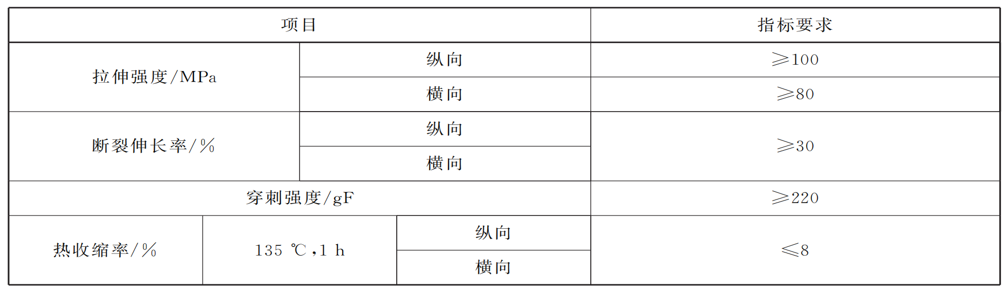
★ Electrolyte requirements
◆ Moisture content ≤20ppm
◆ Hydrofluoric acid content: ≤100ppm at the time of incoming materials, and ≤200ppm for subsequent testing.
7. Production quality management requires systematic construction (Chapter 9)
For the first time, the new standard makes production quality control mandatory, standardizing the production environment and process control of production enterprises, reducing the risk of internal short circuit of batteries and ensuring the consistency of product quality.
◆ The production quality management of lithium-ion batteries for mobile power supply shall meet the requirements of applicable clauses in GB/T47292.3.
◆ Lithium-ion battery manufacturers should have the complete battery production capacity specified in the standard.
◆ The production quality management of lithium-ion batteries for mobile power supply shall meet the requirements of applicable clauses in GB/T47292.4.
◆ The production quality management of mobile power supply shall be implemented according to the relevant requirements of battery pack.
Important implementation time nodes of the new national standard
-March 31, 2026: The standard is officially released, and enterprises can start product rectification, testing and certification preparation.
-April 1, 2027: The standard is officially enforced, and mobile power sources that do not meet the standard may not be produced, sold, imported or provided.
Warm tips
The implementation of the new standard is not only a challenge, but also an opportunity for the industry to reshuffle and upgrade. ZRLK testing suggests that relevant enterprises seize the opportunity of transition period, quickly complete product self-inspection and rectification against the standard, and start compliance work in advance to avoid queuing in the near future and affecting product listing. Our company has complete mobile power detection capability and rich certification experience, and can provide full-process compliance services for enterprises:
Standard Interpretation and Scheme Customization: Customize personalized rectification and certification scheme according to the current situation of enterprise products.
Full-project testing service: covering all testing items in the new national standard, and quickly issuing authoritative testing reports.
Certification counseling and process follow-up: follow up CCC certification and other compliance processes throughout the process to get the certificate efficiently.
Factory audit and system guidance: assist enterprises to improve the production control system and meet the standard requirements.
Technical training and continuous support: provide enterprises with standard training and technical answering questions to help products upgrade iteratively.
If you need it, please feel free to contact us, and our engineers will serve you at the first time!